-

-
-
Product

Solutions
One app, all things legal

Compare
-
-
-


 Gmail
Gmail  Microsoft 365
  Wisetime
  Dropbox
  Zapier
  Quickbooks
  vs CosmoLex
  vs PracticePanther
  vs AbacusNext
  vs Caret Legal
  vs Clio
  vs MyCase
  vs Smokeball
  vs Filevine


Law Firm KPIs: The Metrics Every Managing Partner Should Track
8th October 2026
Revenue tells a managing partner what happened. A focused set of law firm KPIs explains why it happened, where performance is leaking, and what the firm should do next.
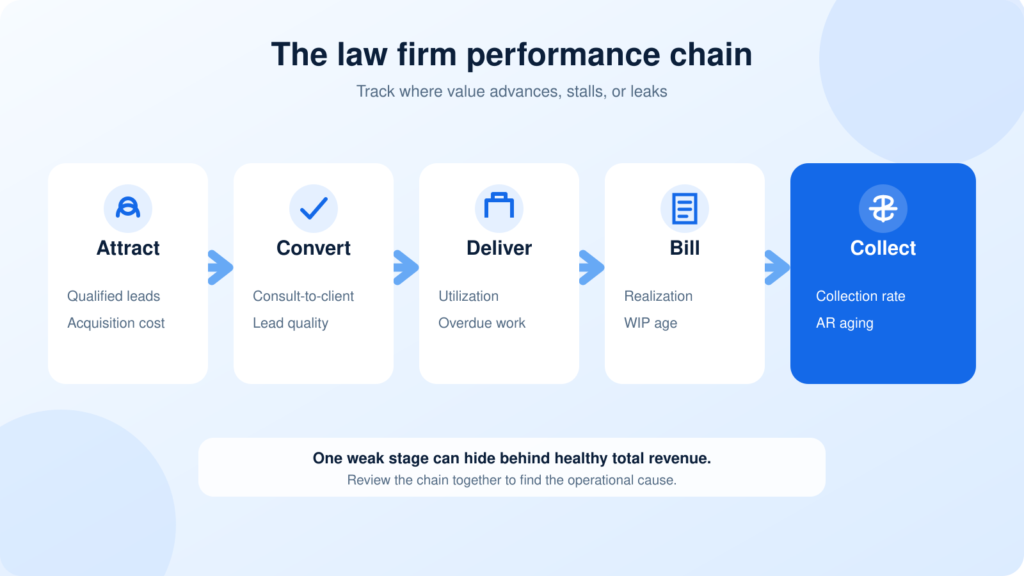
A useful dashboard follows the full client and revenue journey: the right inquiries enter the pipeline, qualified prospects hire the firm, lawyers complete valuable work, bills go out accurately, and cash arrives on time. Measuring only billable hours or total revenue hides problems between those stages.
The American Bar Association’s 2026 guidance on law firm profitability recommends connecting financial, operational, and marketing measures instead of reviewing them in isolation. The goal is not a forty-metric report. It is a short, consistent scorecard that supports decisions.
Start with a decision dashboard, not a data dump
Every KPI should answer three questions: Who owns it? How often is it reviewed? What action follows when it moves outside the firm’s target range? Without those decisions, a dashboard becomes a collection of interesting numbers.
Use one agreed definition for each metric. For example, decide whether realization is based on hours or value, whether revenue is recorded when billed or collected, and which costs belong in matter profitability. Keep the formula stable long enough to see a real trend. Industry benchmarks can provide context, but your firm’s practice mix, pricing model, staffing, and market should determine its operating targets. Clio’s law firm KPI benchmark library is a useful external reference for utilization, realization, collection, and lockup definitions.
Separate leading indicators from lagging outcomes. Consultation bookings, time entered promptly, overdue tasks and unbilled work signal what may happen next. Collected revenue, realization, client retention and matter profitability describe results after decisions have played out. Review both together: if consultation bookings rise but new engagements stay flat, inspect qualification and follow-up; if billable work rises but collections fall, inspect invoice timing and outstanding balances. This distinction helps partners act early without mistaking activity for success. Choose one leading measure for each outcome, assign an owner, and revisit the pair on a consistent cadence.
The 12 law firm KPIs managing partners should track
1. Qualified lead-to-consultation rate
Formula: qualified leads that book a consultation divided by total qualified leads.
This shows whether intake staff, response time, scheduling, and follow-up are moving the right prospects forward. Segment it by referral source and practice area. A high booking rate from a low-fit source is not automatically good. Pair the rate with lead quality and expected matter value.
2. Consultation-to-client conversion rate
Formula: new clients retained divided by completed consultations.
Review this by attorney, practice area, and source. A falling rate may signal slow engagement-letter delivery, unclear fees, inconsistent follow-up, poor qualification, or limited capacity. It should prompt a review of the intake journey, not pressure lawyers to accept unsuitable matters.
3. Client acquisition cost by source
Formula: marketing and sales cost for a channel divided by clients retained from that channel.
Use collected client value, not lead volume alone, to judge a channel. A source that produces fewer but better-fit clients may outperform a high-volume source. Connect acquisition cost with conversion, average fee, matter profitability, and referral potential.
4. Utilization rate
Formula: billable hours worked divided by available working hours.
Utilization reveals how much available capacity reaches client work. It can expose excessive administration, uneven workloads, missing time, or process friction. Compare similar roles rather than imposing one target on partners, associates, paralegals, and administrative staff.
5. Realization rate
Formula: value billed divided by standard value of billable work.
Realization measures how much recorded work reaches an invoice after discounts, write-downs, caps, and pricing adjustments. If utilization is healthy but realization falls, inspect matter scope, staffing, time-entry quality, fee arrangements, and invoice review delays.
6. Collection rate
Formula: amount collected divided by amount billed.
Collection rate shows whether invoices become cash. Review it alongside days to payment and accounts-receivable aging. Declines can come from unclear bills, slow invoice delivery, poor retainer management, client dissatisfaction, or inconsistent follow-up. The Lawcus billing and invoicing guide explains how billing, payments, and financial reporting connect in one workflow.
7. Lockup and accounts-receivable aging
Lockup is the time between doing work and receiving payment. Track unbilled work in progress and unpaid invoices separately. Then group receivables into age bands such as current, 31 to 60 days, 61 to 90 days, and more than 90 days.
A rising lockup figure can make a profitable firm feel cash-poor. Assign owners to draft billing, invoice approval, follow-up, and payment-plan decisions so work does not stall between stages.
8. Work-in-progress age
Formula: days from the work date to billing, reviewed by value and matter.
WIP age is more actionable than a total WIP balance. It shows where time or expenses are accumulating without being invoiced. Review older items for missing narratives, approval bottlenecks, fee-limit issues, or work that should be written off.
9. Matter profitability
Formula: collected matter revenue minus agreed direct costs, calculated consistently.
Profitability should be reviewed by matter type, fee arrangement, client, and responsible attorney. A busy practice area can still underperform if scope expands, senior lawyers do work that could be delegated, or collections lag. Avoid using a profitability score as a substitute for professional judgment. Use it to improve pricing, staffing, and matter planning.
10. Revenue per lawyer or full-time equivalent
Formula: collected revenue divided by the relevant lawyer count or full-time equivalents.
This is a high-level productivity and capacity signal, not an individual performance verdict. Trend it over time and interpret it with utilization, realization, leverage, practice mix, and headcount changes.
11. Overdue task and deadline rate
Formula: overdue tasks or deadlines divided by all tasks or deadlines due in the period.
Operational reliability belongs on the managing partner’s dashboard because delayed work can affect client experience, team stress, and risk. Segment the rate by workflow stage and cause. A recurring bottleneck may be solved through clearer ownership, capacity changes, or legal workflow automation.
12. Client experience and referral rate
Use a short post-matter survey, complaint themes, review requests, repeat engagement, and referrals. The simplest referral measure is referred clients divided by new clients. Combine the number with qualitative feedback so the firm understands what clients valued or found difficult.
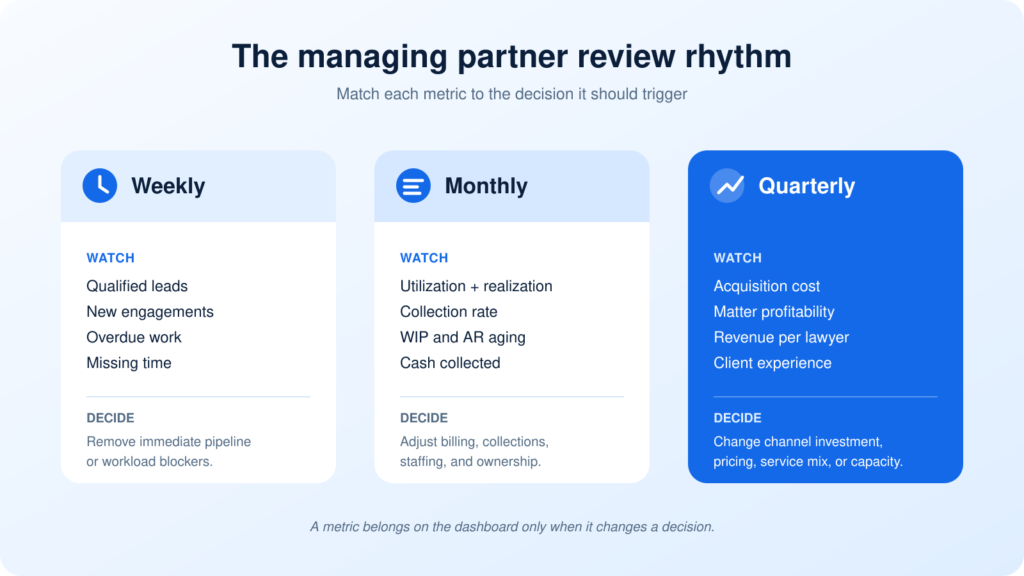
A practical managing partner dashboard
| Review cadence | Metrics | Decision |
|---|---|---|
| Weekly | Qualified leads, consultations, new engagements, overdue work, missing time | Remove immediate pipeline or workload blockers |
| Monthly | Utilization, realization, collection, WIP age, AR aging, cash collected | Adjust billing, collections, staffing, and process ownership |
| Quarterly | Acquisition cost, matter profitability, revenue per lawyer, client experience | Change channel investment, pricing, service mix, or capacity plan |
Keep the dashboard small. Start with eight to twelve measures, assign one owner to each, and record the action taken. Add a metric only when it will change a decision.
How to turn KPI changes into action
- Set a baseline. Use at least three comparable periods where possible. Note changes in staffing, pricing, practice mix, or data quality.
- Choose a target and guardrail. A target states the desired result; a guardrail triggers investigation before performance becomes critical.
- Segment before diagnosing. Break the number down by practice area, source, attorney, matter type, or fee arrangement.
- Name the owner and next action. Every exception should have a person, a due date, and a defined follow-up.
- Review the trend, not one noisy month. Look for sustained movement and annotate unusual events.
How Lawcus supports KPI reporting
Lawcus brings intake, matters, tasks, time, billing, payments, and reporting into one practice-management environment. Its analytics and reporting features include custom reports and views of work in progress, receivables, payments, trust balances, and matter activity. Personalized dashboards and insight cards help users surface performance, upcoming work, missing time, and firm activity without reviewing every record manually.
Reports still depend on consistent data. Define statuses, sources, responsible attorneys, time-entry rules, and matter-close procedures before treating the output as a reliable management scorecard. For client-fund oversight, pair management KPIs with the firm’s required reconciliations and review the available trust accounting workflows.
Frequently asked questions
How many KPIs should a small law firm track?
Start with eight to twelve. Include at least one intake, operations, billing, cash, profitability, and client-experience measure. A smaller dashboard that leaders review consistently is more useful than a long report nobody acts on.
Should we use industry benchmarks as targets?
Use benchmarks as context, not as automatic targets. A contingency-fee practice, an estate-planning firm, and a commercial litigation team have different work cycles and economics. Build targets from your baseline, strategy, capacity, and risk tolerance.
Who should own the law firm KPI dashboard?
The managing partner should own the decisions, while operations, finance, intake, and practice leaders own the accuracy and follow-up for their metrics. Document definitions and data sources so the dashboard remains consistent when roles change.
What should we do first?
Define the three rates that connect work to cash: utilization, realization, and collection. Then add intake conversion, WIP age, AR aging, matter profitability, and one client-experience measure. Review the baseline, select one priority leak, and assign an action before expanding the dashboard.
Categories
Automation BlogsBilling & Accounting BlogsGeneral PracticeMarketing BlogsNews & UpdatesPractice Management BlogsRecent Posts
Introducing Billing and Task Insights in Lawcus
Law Firm KPIs: The Metrics Every Managing Partner Should Track

LEDES Billing for Law Firms: Formats, UTBMS Codes and Setup

12 Law Firm Workflow Automation Examples You Can Implement

Law Firm Client Intake Checklist: From Inquiry to Engagement
Practice Management
Automation
Client Intake & CRM
Billing & Accounting
Practice Area
Compare
Resources
Lawcus Inc.
4445 Eastgate Mall, Suite 200,
San Diego, CA 92121


