-

-
-
Product

Solutions
One app, all things legal

-
-
-

 Gmail
Gmail  Microsoft 365
  Wisetime
  Dropbox
  Zapier
  Quickbooks
  vs CosmoLex
  vs PracticePanther
  vs AbacusNext
  vs Caret Legal
  vs Clio
  vs MyCase


Feature Release: January 2026 Second Spotlight
29th January 2026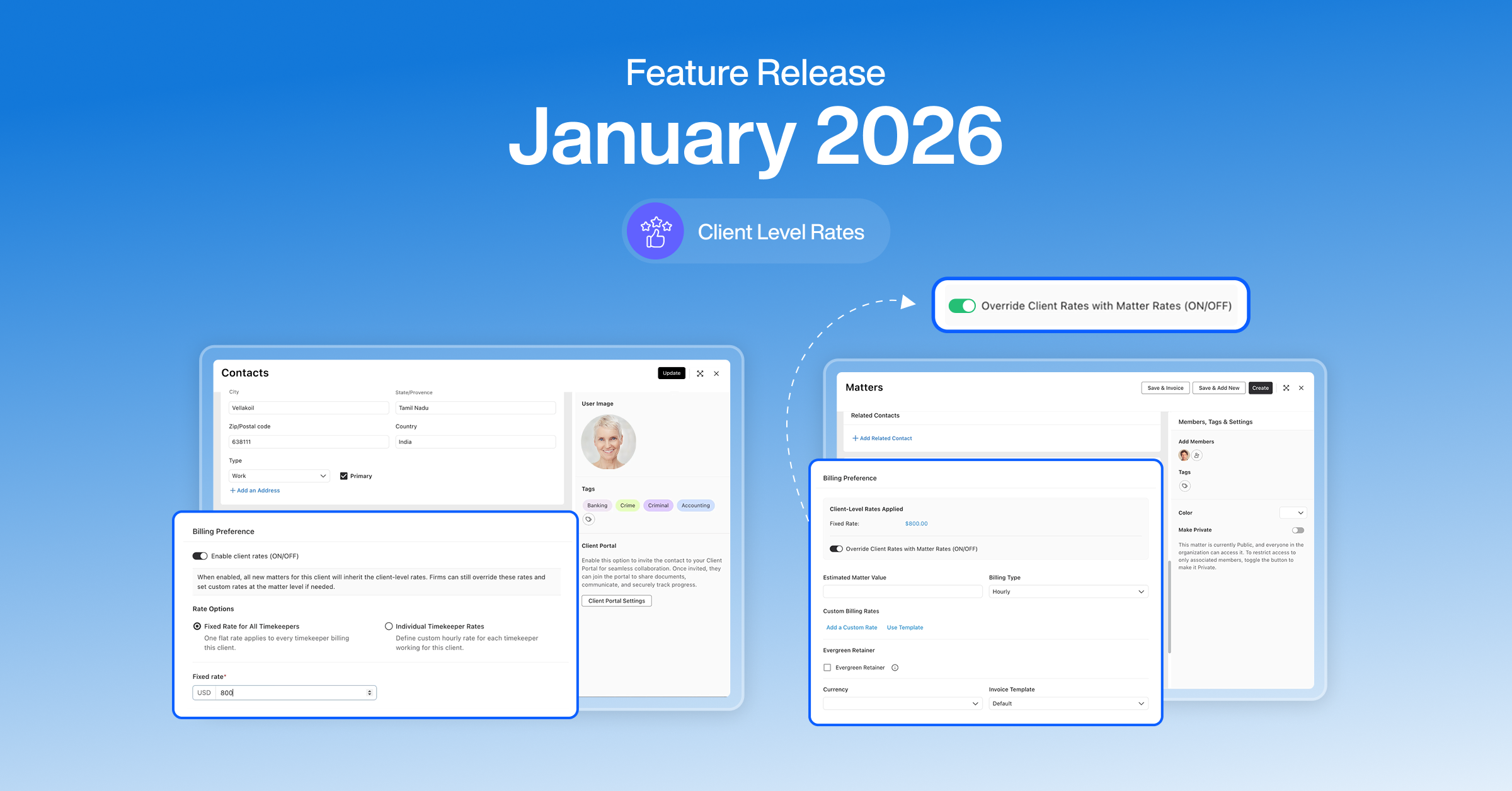
Billing errors rarely come from complex problems — they usually come from repetitive manual work.
In many firms, every new matter requires re-entering billing rates for the same client. Someone forgets a special rate. Time gets logged incorrectly. The mistake gets discovered later during billing — when it’s expensive, disruptive, and frustrating to fix.
As firms scale and client relationships deepen, this manual setup becomes a recurring operational risk. Client-Level Rates removes that friction by allowing firms to define rates once at the client level and automatically apply them to every new matter going forward.
Here’s how it works and why it matters.
Client-Level Rates
If your firm handles multiple matters for the same client, you’ve likely experienced this:
- You open a new matter.
- You re-enter rates (again).
- Someone misses a rate exception.
- Time gets logged at the wrong rate.
- The correction happens later—during billing—when it’s most expensive and time-consuming.
Client-Level Rates is built to eliminate that repetition and prevent downstream billing corrections. With Client-Level Rates enabled, you can define billing rates at the client level. After that:
- Every new matter for that client automatically inherits those rates.
- You don’t have to reconfigure rates each time.
- The firm gets consistent billing behavior across the client relationship.
Two common structures supported (because firms bill differently)
Client-Level Rates supports different real-world billing patterns:
1) One fixed rate for all timekeepers: Useful when a client has a single blended rate.
Example: Insurance defense with a single approved rate
A client might require a uniform rate across all timekeepers for certain matter types. This option makes that consistent and effortless.
2) Individual timekeeper or group rates: Useful when billing differs by seniority or role (which is most firms).
Example: Firm with role-based billing
Partners, associates, and staff bill differently, but the client relationship stays consistent across matters. Group/timekeeper rates let you keep that structure intact.
Flexibility where it counts: matter-level overrides for exceptions
Even when client rates are standardized, some matters need exceptions. That’s why the system allows you to override client rates at the matter level when necessary.
Example: Same client, different arrangement
- Matter A: standard hourly rates
- Matter B: discounted rates for a specific project
- Matter C: special rate for a specific partner
Client-Level Rates gives you structure by default and controlled flexibility when needed.
Note: Enabling Client-Level Rates does not change existing matters. Historical matters remain untouched, past time entries are not altered, and your current billing history stays stable.
Only new matters created after enabling the feature inherit the client-level configuration. That means firms can adopt this without fear of disrupting billing records or creating retroactive inconsistencies.
Client-Level Rates removes repetitive setup and reduces billing errors by standardizing rates at the client level while keeping flexibility at the matter level. Firms save time, improve accuracy, and keep billing consistent as they scale.
New Integrations
VIP VoIP
The VIP VoIP integration with Lawcus connects your firm’s cloud-hosted phone system directly to your practice management platform, streamlining how legal professionals handle communications and related administrative work. When integrated with Lawcus, every call is automatically logged and transcribed within the system, reducing manual work, improving record-keeping, and helping firms stay organized with up-to-date communication histories. This integration not only saves valuable time that would otherwise be spent on repetitive administrative tasks but also enhances client service by ensuring call data and transcripts are captured accurately and stored alongside matters and contacts in Lawcus.
Lead Autopilot
Lead Autopilot is a powerful AI-driven intake and engagement solution that seamlessly integrates with Lawcus to transform how law firms capture, qualify, and nurture leads. With this integration, your firm gains dedicated AI-powered intake specialists that work continuously to sync leads and client information between your marketing funnels and your Lawcus CRM in real time, helping ensure timely and consistent outreach. Lead Autopilot can handle full intake cycles, including call handling, phone routing, automated qualification, questionnaire distribution and collection, document management, and custom field updates while keeping all data accurate and organized within Lawcus.
What this release unlocks for firms
Client-Level Rates removes repetitive setup, reduces billing errors, and keeps client billing consistent as firms grow. Instead of resetting rates matter after matter, firms define billing rules once and let the system enforce consistency automatically, while still allowing controlled flexibility when exceptions are required. The result is a firm that can grow without layering on manual processes, as the system begins to carry more of the operational load.
If you have any questions, need help enabling these features, or would like to explore how they fit into your workflow, please contact support@lawcus.com. We’re always happy to help.
Categories
Automation BlogsBilling & Accounting BlogsGeneral PracticeMarketing BlogsNews & UpdatesPractice Management BlogsRecent Posts

Feature Release: August 2026
The Lawcus Mobile App Is Here: Manage Legal Work From Anywhere
Legal Software for Global Law Firms: Introducing Multilingual Support in Lawcus
Turn Estate Planning Intake into a Living Client Record with Lawcus + Eternal Pro
Introducing Matter Insights in Lawcus: Real time Clarity into your Firm’s Matter Activity
Practice Management
Automation
Client Intake & CRM
Billing & Accounting
Practice Area
Compare
Resources
Lawcus Inc.
4445 Eastgate Mall, Suite 200,
San Diego, CA 92121


